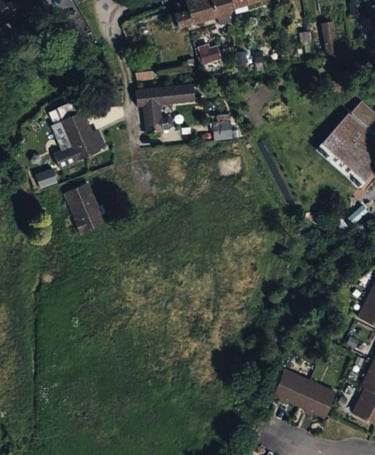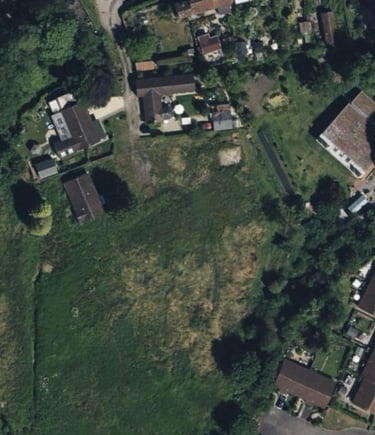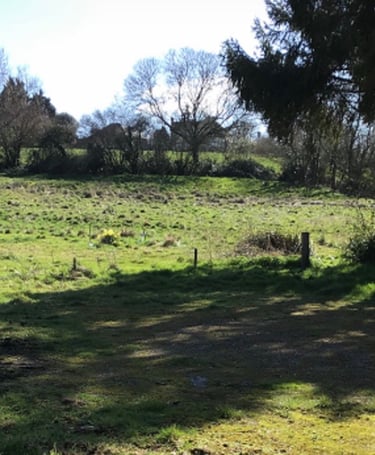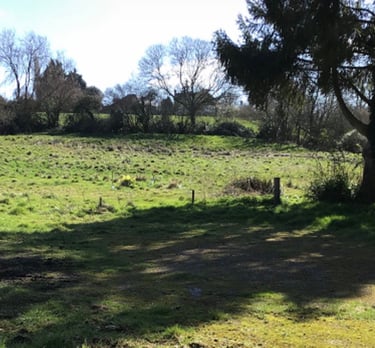

The History of Foxes Run
This website has been created to be an information hub for all things Foxes Run. To keep you fully up to date with news & developments regarding the Judicial Review.
If the animals could donate, they would too!
A Brief Overview of the 18-Year Planning History of Foxes Run
For over 18 years, proposals to develop housing at the Foxes Run site in Castle Cary have faced repeated challenges. The principle issue has never been housing itself, but the safety and suitability of the proposed access arrangements, particularly the use of Mill Lane.
Since the late 1980s, planning policy has consistently recognised Mill Lane as a narrow residential lane intended to remain a cul-de-sac. When nearby developments were approved in the early 1990s, conditions were imposed specifically to prevent access through Mill Lane due to highway safety concerns at the Station Road junction.
Multiple planning applications for Foxes Run, submitted between 2008 and 2016, were refused on similar grounds, with Planning Inspectors repeatedly identifying access, traffic movement, and pedestrian safety as critical issues. Where approval was eventually granted at appeal in 2019, it was only on the basis that a one-way Traffic Regulation Order (TRO) was secured, confirming that unrestricted two-way traffic was considered unsafe.
Subsequent attempts to implement a TRO were unsuccessful, and in 2026 an appeal decision removed the requirement for the TRO altogether. This marked a significant departure from earlier findings and has prompted ongoing concern from residents, leading to the current Judicial Review.
In summary, the long planning history of Foxes Run reflects persistent and unresolved access and safety concerns, rather than opposition to development in principle.
Planning Applications & History Timeline
1987 – Wincanton Local Plan
Mill Lane intended to remain a cul-de-sac.
1992 – Brookfields (73 dwellings)
Condition imposed preventing connection to Mill Lane.
(Reason) Safety concerns at Mill Lane / Station Road junction.
Local Plan 1991–2011
HG/CACA/2 Land West of Remalard Court, Castle Cary (the previous name for the site).
In the South Somerset Local Plan Review (Preferred Options / early stages of the 2016–2036 plan), there was an explicit option to delete the allocation on the basis that earlier planning applications on the site had been refused and the access arrangements were problematic. No objections were logged to its removal at that stage.
Because the Local Plan review progressed only partially before the introduction of the unitary Somerset Council and planning changes, that Preferred Options deletion hasn’t yet been formally adopted into a final Local Plan document. However, it shows the intent to remove the allocation from the statutory development plan if & when the new Local Plan is adopted.
Note: Prior to the first Planning Application, the developer’s solicitor at the time stated in writing to the LPA that the access could be moved to its current location for Foxes Run (Mill Lane), subject to the demolition of an old barn. Instead, that barn was converted in 1996 and is now a residential property sitting directly on the access to the Foxes Run site.
Planning Applications – Foxes Run
2008 – Application 08/00189 (29 dwellings)
Refused.
Inspector supported one-way Mill Lane + TRO.
Appeal refused. Appeal failed on other grounds.
2014 – Applications 14/04031 & 14/04795 (27 dwellings)
Refused.
Included one-way system.
Refused due to safety & amenity concerns.
2016 – Application 16/03447 (27 dwellings)
Refused, then approved at appeal.
Initially proposed two-way traffic (rejected).
Approved only with Condition 16 requiring a one-way Traffic Regulation Order (TRO).
One-way system confirmed necessary for safety.
Post-Approval 2023–2024
Two TRO attempts, both one-way & two-way, failed.
January 2026 – Appeal Decision
Approved at appeal to amend Condition 6 (CEMP) and remove Condition 16 (TRO
In the Inspector’s Decision he states:
“It is clear that, at present, vehicles are able to use Mill Lane to access the properties along it, including service vehicles such as refuse lorries.”
We dispute the factual basis for that conclusion. We contend that refuse lorries do not use Mill Lane. The Judicial Review challenges this aspect of the reasoning.
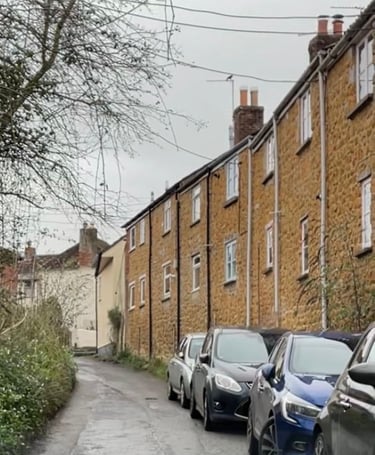
This Decision, as it stands, means Mill Lane will remain two-way with no parking restrictions, with a ~2.6m width with parked cars, and the revised CEMP now allows construction traffic to use Mill Lane / Bridgwater Buildings for all site access.
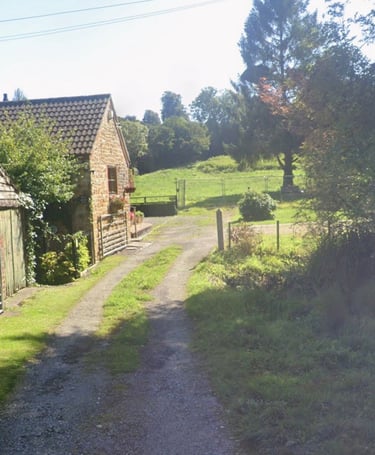
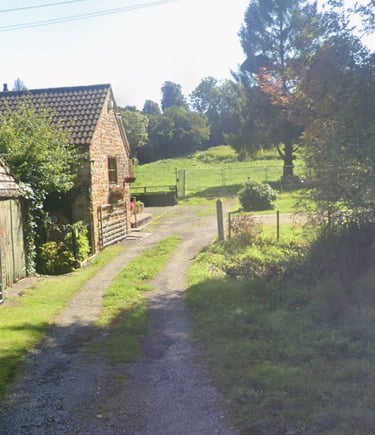
Proposed Mill Lane Access
Key Dangers & Planning History & Why the Removal of Condition 16 Raises Safety & Construction Traffic Concerns
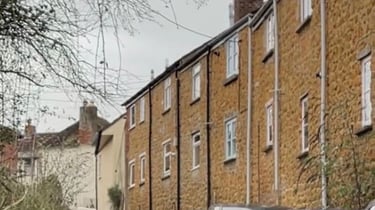
Mill Lane is too narrow for two-way traffic; parked cars already restrict width
Residents must park on Mill Lane; no alternative parking provision
Large vehicles (including refuse trucks) do not and cannot safely pass
(~3.4m pinch point reduced to ~2.6m with parked cars)There is a weight restriction of 7.5 tonnes on Torbay Road, so entry via Brookfields would be prohibited
The use of Mill Lane by construction lorries / cranes / piling rigs / drainage vehicles raises serious practical concerns
Increased right turns onto Station Road with poor visibility; previous Inspector found a one-way system was necessary for safety reasons
Pedestrians at risk, including school children, elderly residents, disabled users, dog walkers
Fear of potential conflict and distress for residents using their own existing access route
Two Planning Inspectors previously confirmed a one-way system is essential for safety
Removing Condition 16 allows unrestricted two-way traffic despite earlier safety findings
Proposed routing via Mill Lane is described as impractical and unsafe
No swept-path tracking provided to prove large vehicles can pass parked cars
Waste vehicles already refuse to enter the lane due to width restrictions
Conflict likely between construction traffic and residents accessing existing homes
What Is the Judicial Review Process?
Stage 1 – Decision Issued (13 January 2026)
The Planning Inspectorate allowed a Section 73 appeal removing the need for pre-commencement Condition 16 (set at appeal in 2019) and amending the CEMP (Condition 6).
Stage 2 – Pre-Action Letter (19 February 2026)
The legal team writes formally explaining why the decision is unlawful.
Stage 3 – Claim Filed (within 6 weeks)
Judicial Review claim issued in the Administrative Court.
Aarhus cost protection applies.
Stage 4 – Permission Stage
(Judge reviews case on paper.)
Permission granted = move to full hearing
Permission refused = option to request short oral renewal
Stage 5 – Full Hearing
(Court hears legal arguments.)
Focus:
Was Section 73 lawfully used?
Were legal limits respected?
Were proper reasons given?
Stage 6 – Judgment
If successful:
Decision quashed or returned to Planning Inspectorate for lawful reconsideration.
If unsuccessful:
Decision to allow the CEMP revision and remove the need for a TRO stands.
Judicial Review – What Happens to the Raised Funds?
Q: What happens if the Planning Inspectorate withdraws the decision at the Pre-Action (PAP) stage?
This is the very first stage.
If the Planning Inspectorate agrees to withdraw and redo the decision in response to our pre-action letter, the case would not proceed to court. The funds raised would first cover any legal costs already incurred. We would normally seek to recover those costs from the Planning Inspectorate. If those costs are recovered, our intention is to repay donors proportionately from any remaining fund.
Q: What happens if the case goes to court and we win?
If we are successful, the court would normally order the Planning Inspectorate to pay our reasonable legal costs. The funds raised would cover costs incurred during the case, and if those costs are recovered, our intention is to repay donors proportionately from any remaining funds.
Q: What happens if we lose?
As this is an environmental judicial review, Aarhus cost protection applies, meaning our potential liability for the other side’s costs is capped. The funds raised would be used to cover our legal costs and any capped adverse costs. We would provide a full breakdown to supporters.
This is the worst-case scenario, and raised funds would need to be used for costs. Whilst it is impossible to know what could happen, after very careful consideration, we have taken legal advice and consider the claim to be arguable.
A financial summary will be provided to supporters at the conclusion of proceedings.
Why Has the Foxes Run Site Faced So Much Concern & Opposition?
For over 18 years, the proposal to build houses on the Foxes Run site has proven to be somewhat undeliverable. It has never been about the building itself, but about ensuring access is safe — not just for the new 27 houses, but for all existing residents directly affected.
This always leads back to one question:
Why was access proposed via Mill Lane rather than Remalard Court?
We may never know.
Why Was There a Need for a TRO, What Does It Do & Why It Matters in Our Judicial Review?
Traffic Regulation Orders (TROs) are legal tools used to control traffic, for example adding yellow lines, restricting access, or erecting signs that prohibit or restrict road use.
Whilst residents did not want restrictions that would disrupt the long-standing use of residential roads outside their homes, without a TRO the developer cannot use restriction mechanisms or signage to enforce what they are trying to create. This raises serious safety concerns for residents of Bridgwater Buildings and Mill Lane, and also for the road junction at the bottom of Mill Lane and Brookfields.
Residents are concerned about potential liability issues, and questions arise regarding responsibility should incidents occur.
When the new unitary authority, Somerset Council, was created, it adopted a new constitution (its internal rulebook). There are questions about whether the Constitution clearly allocates decision-making authority for TROs. If the Constitution does not clearly allocate who has authority to make, confirm, or revoke a TRO, this raises questions of public law which are outside the scope of this summary.
What About the Bomb?
During the Luftwaffe raids in 1942, bombs were dropped in several locations in Castle Cary. There is first-hand evidence from the owners of Foxes Run at that time, including a book entry written by them (Somerset – Within Living Memory), that a bomb was dropped in their field.
“UNEXPLODED BOMBS – During the war Castle Cary was a busy place… Presumably, the bomb has worked down forever…”
There have been various requests during the planning process, including from residents, for further investigation. The developer indicated that a formal threat assessment was not required. Especially as the developer has confirmed the requirement for pile foundations. This issue is not part of the current Judicial Review but remains a matter of local concern.
There is local understanding passed on over the years that its location is marked each year with a mound of daffodils.
Flooding, Springs & the Pumping Station
The proposed site has been under development for 18 years; however, the most recent ground investigations were undertaken several years ago. Given the spring-fed, elevated riverside setting, ground and slope conditions may have altered significantly during this period.
Residents are concerned that impact pile driving could disturb groundwater regimes and potentially trigger slope instability, posing a credible risk to downslope properties, particularly an 18th-century barn conversion with no formal foundations.
In addition, the developer proposes to locate a private pumping station approximately 3 metres upslope of the same property. Submitted drawings indicate the structure may encroach onto adjoining land. Wessex Water requires a minimum 15-metre separation between such installations and residential properties to mitigate risks associated with odour, vibration, and operational failure. This would be an Environmental Health issue.
Party Wall etc. Act 1996 & CDM 2015 Regulations
There are properties located directly at the entrance to the site, where a pinch point occurs at the culvert crossing over the River Cary. This culvert is constrained in width that lies within the developer’s land ownership. These properties are likely to fall within the scope of the Party Wall etc. Act 1996.
There are also significant concerns regarding compliance with CDM Regulations, as the design of the proposed single-file, give-way section of road does not appear to adequately account for existing properties. In addition to concerns relating to potential trespass and obstruction of access, consent from Historic England and the Environment Agency may also be required.
These matters are separate from planning permission because they relate to private legal rights, statutory obligations, and regulatory consents — including land ownership and third-party approvals — which are not determined or overridden by the granting of planning permission.
Even if the Council or Inspector says the project is allowed from a planning point of view, that decision does not cancel or override these other legal requirements.
So, in summary:
Planning permission is only one piece of the puzzle. The developer will still need other approvals before they can go ahead.